Untethered Sounds
A summer playlist of the Acousmatic

As we prepare for the midsummer magic of Lughnasadh, we give gratitude to plentiful Earth and the bounty she bestows. From nectarines, peaches, and raspberries to chokecherries, Zwetschgen, and Charentais melon, summertime is goodeatin’ time, whether you’re poolside, dockside, oceanside, or simply patioside, between the Weber and the Igloo.
Michael Eisenberg is an avid, deep listener of Acousmatic music, which he defined and explained in a previous article. He is an editor at Metapsychosis and writes for Avant Music News. This quarter, we’re publishing Michael’s playlist in time for July’s full Buck Moon, named for the time of year when male deer are fruiting their new antlers. The Old Farmer’s Almanac says now is also the best time for fishing. Go low-tech, get out on the water, and tune in.

Summer is a season of extended attention. Light remains after the day seems finished, conversations continue into the evening, and familiar places reveal details that pass unnoticed during busier months. Acousmatic music asks for a similar patience. Rather than rushing toward recognition, attention lingers with sound long enough for the encounter to deepen.
Below are two Acousmatic albums for the third seasonal installment of Untethered Sounds on the Weirdosphere Substack. If you haven’t checked them out already, the Spring playlist is here, and the Winter playlist—which includes a potted history of the Acousmatic, along with some suggestions on how and why to listen to this music—is here.
The season reminds us that recognition need not conclude listening. The cricket remains a cricket; the wind remains wind as it moves through the willows; the distant thunder of a summer storm remains thunder. Yet when attention continues beyond identification, familiar sounds often disclose qualities that cannot be reduced to their sources alone.
Summer has a way of blurring the boundary between inside and outside. It’s a time to keep the windows open, to let the neighborhood into the house, and, for that matter, the house into the neighborhood. Sounds seem to travel farther as listening ceases to be directed toward discrete objects and gives way to immersion in an acoustic field.
It’s into this field that the attentive listener can wander. Sometimes, through sustained engagement with sound—or what Pierre Schaeffer called reduced listening, a deeply attentive way of approaching the sound object—a bond begins to form. The listener may develop a relationship that feels personal. Instead of hearing a thing that produces sound, the sound itself may become an “other.” As Henry Corbin would say, an incorporeal corporeality. The listener may find themselves in the presence of a being possessed of intelligence, perhaps even consciousness.
What would this be like for the listener? Would visual images of the sound itself begin to manifest? Would the listener sense an emotional shift, an affect that was not apparent before the encounter but is present here and now? Might these feelings eventually assume imaginal form? Think about the sounds of summer where you live. Choose a time of day to step outside and simply listen to the entire sonic tableau spread out before you. As a listener, you may experience it as a single, vast sound object. Let your attention settle on the sounds around you and remain awhile in this meadow of sound. Stay with it beyond the point of recognition, allowing duration to deepen the encounter. Notice the details. Linger if you wish before saying goodbye and moving on to the next sonic offering. Perhaps, within this living Earth of sound on a summer morning or evening, what first appeared as merely a sound object may disclose itself as a presence—and notice you, too. And when that happens, the conversation has only just begun.
I realize that in my previous two playlists I’ve neglected some very important, groundbreaking artists in the Acousmatic world. This time I’ve decided to focus on just two composers whose work I should have included long ago. Even though I’m writing about only one album by each, I hope you’ll take the initiative to explore their catalogs further. Much of their music is available on Bandcamp. You won’t be sorry.
Tod Dockstader. Tod began his career in Hollywood as an apprentice film and sound editor working on animated classics such as Mr. Magoo and Gerald McBoing-Boing. In the late 50’s after moving to New York, he began experimenting in his free time with mixing and manipulating sounds on magnetic tape. Throughout the 60’s, he composed many pieces of sound art. These works were composed the old-fashioned way: by cutting, splicing, and rearranging magnetic tape into finished compositions. His work during this period was influenced by Edgar Varèse’s Poème électronique who reportedly suggested they work together. Unfortunately, that meeting never came to fruition but, at least in my mind, it’s one of the great “what if” moments in musical history.
In the late 90’s, with urging from his daughter, he bought his first computer and realized its potential for music creation. His later works were the result of his interaction with this newfound technology.
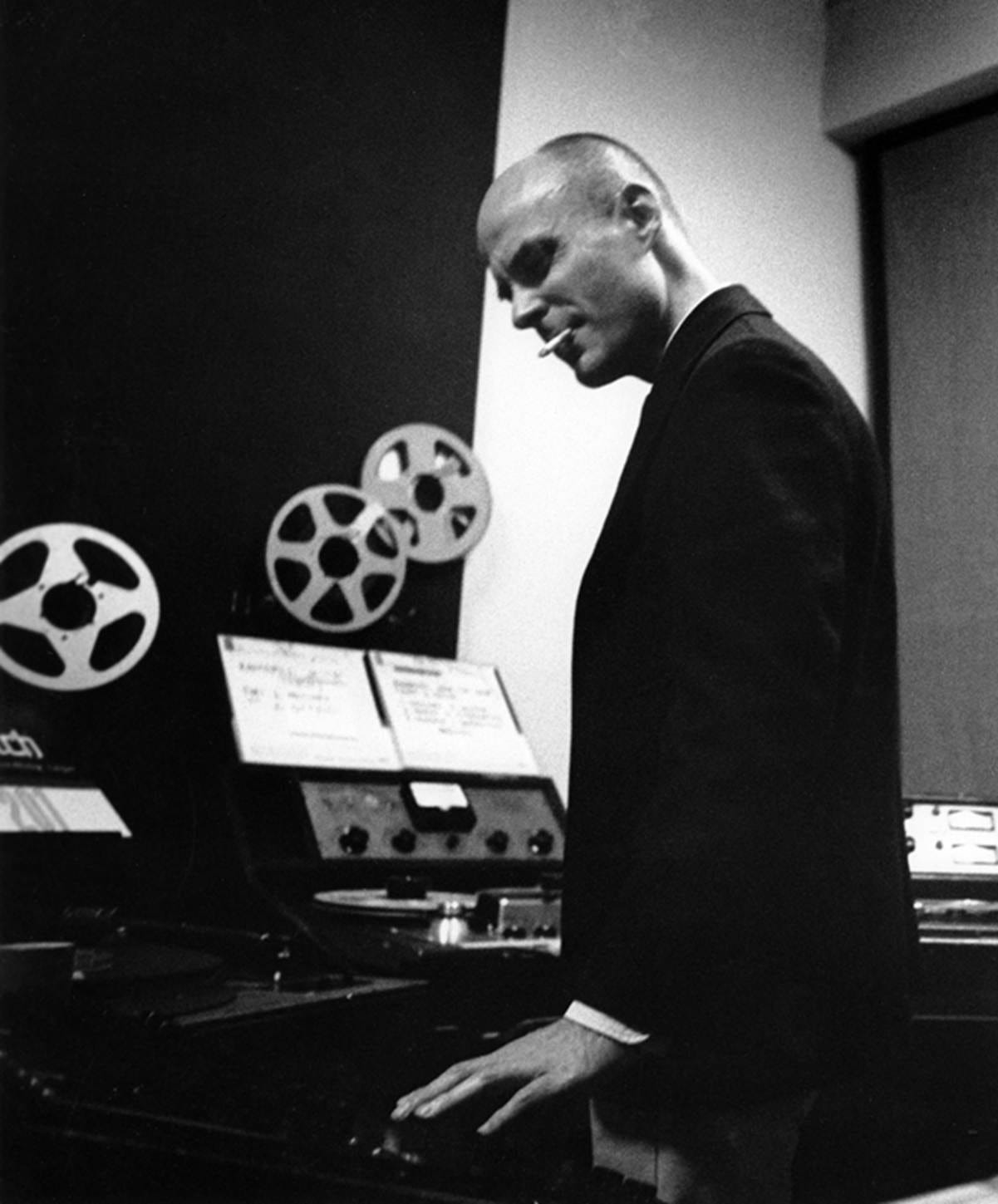
For this playlist, I’m going to concentrate on one release (of three) of his earlier works from the 60’s, lovingly brought into the light by the Starkland label. The album is called Quatermass.
Revisiting these pieces, it amazes me how well they’ve aged. The first work, Water Music, contains meticulously organized, exquisitely manipulated tape snippets of… mostly water. Other sound sources make cameo appearances such as toy gong-rattles, Indian finger bells, sheet of metal, two test generators (rewired for instability), two water glasses, a Coke bottle, a metal garbage can (to hold the water), and a nail.
Ah yes, the sound of water, along with the sound of clacking ping pong balls, one of the most used sound sources in Acousmatic music. But, listening to Water Music now, in 2026, I’m completely flabbergasted at how fresh, innovative, and forward thinking this sounds. Remember, these pieces are all hand assembled—cutting and splicing magnetic tape to an extreme level of detail. The sounds heard are not of this world, and I’d be hard pressed to imagine another world from which they came. But I do, and it’s weird… and so might you, especially if you give it a good headphone-listen.
After a short interlude called The Two Moons of Quatermass which was unused music for the larger upcoming piece, we encounter the 45-minute magnum opus called Quatermass. Again, I feel the need to remind you that this piece was composed and rendered in the 60’s. Recording tech back then was not even remotely close to what we have in our current day.
Yet the piece sounds like it was created using tech that hasn’t even been invented. The alien nature of the sounds leaves the mind in such a state of disarray that all the listener can do is cry uncle and live within its duration. I think the best way to describe this piece is an avant-prog, dark-hued, Bartók-inspired, electro-weirdness, acousmatically built monolith.
The sounds used as building blocks are steeped in mystery. Solomon himself would be hard pressed to direct his temple-building demon workforce to procure such materia prima. There are passages of lowercase ambience, but they exist only to heighten the drama that follows. The final 14-minute movement enters a cosmic miasma of ascending and descending siren-like sonic waveforms, some layered on top of one another. The layers are punctuated by harsh, cacophonous, orchestral-sounding percussion blasts, augmented by electronic arpeggios, scratches of dirty static, and massive gong strikes that just might make Carl Palmer soil his underwear.
Ok, maybe I’ve gone too far… but maybe I haven’t.
Check it out!
Trevor Wishart. Earlier I suggested stepping outside for a while and simply listening to the sounds of summer until they begin to reveal something more than their everyday identities. Wishart approaches listening from the opposite direction. Rather than uncovering another world hidden within familiar sounds, he builds one from scratch. There are moments when you think you’ve recognized something—a voice, an animal, a machine—but the certainty never lasts. The sounds keep changing, transforming into something else before you can quite pin them down. Eventually, you stop trying to identify what you’re hearing and simply allow yourself to inhabit this strange acoustic landscape on its own terms. It’s an odd place to visit, but once you’re there, you may find yourself wanting to stay awhile. His early work Journey into Space is one of the finest invitations I know to make that trip.
Wishart is an educator, author, and sound artist based in York, England. He is best known as an electroacoustic composer, and he’s even developed his own software to facilitate this. Working out of York University’s Electronic Music Studio, Wishart composed Journey into Space in the early 1970s, his first major release.
The nearly 80-minute piece is a sprawling, shifting thing, from Luc Ferrari type soundscapes to more electronically treated movements. If the sounds of summer can become a landscape through attentive listening, Trevor Wishart examines what happens when the landscape itself is made entirely of sound. In the long, second movement, Journey, the listener traverses a dimly lit shadow world of metallic resonances, disembodied voices living and breathing within grainy static, uncanny animal/human/animal bleatings, and soaring horn-like fanfares. It’s a constantly morphing landscape that calls down desert atmospheres at night and possible terrors over your shoulder.
The whole piece exudes a Night Land of William Hope Hodgson’s most vivid and lucid horrors. But there is no haven here, no possible Redoubt. To my ears, this is decidedly not a journey into the outer spaces of the celestial spheres; it’s more a crawl through an earthly dreamscape of wonder and nightmares. Rather than evoking the vast reaches of the stars, I hear endless caverns, ruined temples, subterranean seas, forests that have never known daylight, impossible cities that appear and disappear without warning, and colossal forgotten engines still grinding away somewhere beneath it all.
It feels like wandering through a place where every path leads deeper underground, where every chamber opens onto another chamber, stranger than the last. Every sound hints at something just beyond hearing, as if the landscape itself were trying to tell you something without ever quite saying it. I keep expecting to round a corner and find some impossible creature staring back at me, or an abandoned civilization still dreaming beneath layers of stone. No, this is no outer space journey; it’s a slow descent into a world that seems to have been waiting for someone to listen to it.
I’ll say one final word about this piece, and it’s a word that you’ve heard me say many times in the past: Headphones!
See you in the Fall
Michael
Michael Eisenberg is an editor at the Metapsychosis Journal of Consciousness, Literature, and Art. As part of his curatorial work for the Acousmatic Crossings series at Metapsychosis, Michael hosts Live Diffusion calls, scheduled Zoom sessions featuring artists who have or will be writing essays for the series. Michael’s passion project is to overlay esotericism, both ancient and modern, on top of Acousmatic music to discover connections, correspondences, sympathies, and synchronicities which aid the listener in receiving an integrative, imaginal experience. Across his writing, Michael demonstrates how Acousmatic music removes the visual source of sound purposefully; encourages deep, imaginative listening; allows sound to become symbolic rather than representational; gives the composer granular control over sonic “geometries”; and creates a liminal space where listeners can encounter non‑ordinary states.